Home
» 🧠 ADHD
»
ADHD Awareness Month 2026: Document a Child’s School-Day Strengths and Difficulties
ADHD Awareness Month 2026: Document a Child’s School-Day Strengths and Difficulties
During ADHD Awareness Month in October 2026, a parent might decide to bring something more useful than a vague account of a “hard school day” to the next conversation with a teacher or pediatrician. A short, balanced record can show when a child succeeds, where a task breaks down, and what support was present. It cannot diagnose ADHD, and it should never reduce a child to a collection of problem behaviors.
Illustrative example, entirely fictional: Maya is an elementary school student who loves explaining science ideas aloud. Her caregiver notices that completed worksheets sometimes stay in her backpack, while her teacher says she participates readily in group discussions but has trouble beginning independent written work. Maya, her school, and all observations below are invented to show how a family could organize information. They are not a case study or a tested result.
October is recognized as ADHD Awareness Month by the ADHD Awareness Month coalition described by CHADD. The month can prompt a conversation, but there is no special October-only test or school procedure. The CDC’s diagnosis guidance, updated July 2026, explains that ADHD assessment has several steps, uses information from different settings, and considers other possible explanations. The record below is a way to prepare for those conversations.
1. Gather existing work and name strengths first
A caregiver organizes school papers and a notebook before selecting a few dated examples of work and participation.
Start with material that already exists: a teacher’s message, a dated assignment, a report card comment, or a note about a classroom routine. Choose a small number of examples that illuminate a question. A stack of every page from the semester makes it harder to see a pattern. Keep original wording when quoting a school communication, and label your own interpretation separately.
For fictional Maya, a useful starting note might read: “Enjoys discussing science; explains an idea clearly to a classmate. On two returned writing assignments, the first sentence is missing even though she could explain her answer aloud.” The two assignment observations are invented for the example. This note does not prove that attention caused the difficulty; it identifies a difference worth asking about. It also ensures the discussion begins with what Maya can do.
Ask the teacher what circumstances help the child show those strengths. Was the discussion in a small group? Did an adult give the first instruction one at a time? Does the child finish work more readily after seeing an example? Documenting the setting alongside the outcome makes a strength actionable: the team can consider how to make successful conditions available more often. Keep a copy of the source work or message with the date, and avoid sharing other students’ names or personal details.
2. Write brief, observable school-day notes
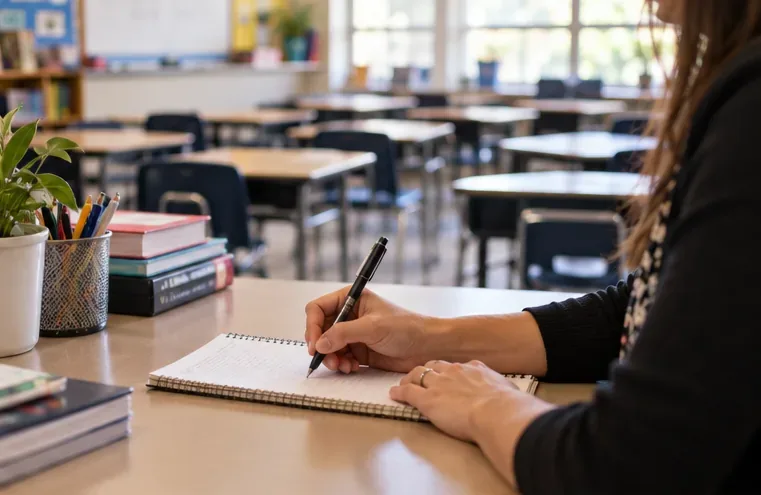
A teacher records a brief classroom observation; the useful note describes the task, setting, support, and what happened next.
Agree on a manageable way to exchange observations with the teacher. A family should not expect an educator to produce a minute-by-minute diary. One or two specific observations around a recurring concern can be more informative than daily labels such as “unfocused” or “good.” Record the date and approximate part of the day, the task, what an adult could see or hear, the support offered, and the result. Also record at least one successful moment. A parent can separately note what happens at home when a similar demand appears.
What to note
Fictional Maya example
Setting and task
Independent paragraph writing after lunch
Visible difficulty
Opened notebook but did not begin the first sentence during the initial work period
Support and result
After the teacher reviewed the first instruction with her, she wrote an opening sentence
Strength on the same day
Explained a science diagram clearly during small-group discussion
These are hypothetical observations, not measurements from a real student. If a duration or frequency matters, record it only when someone actually observed it; do not invent precise numbers afterward. Include days when the concern does not appear. A pattern that changes with task type, time of day, or the clarity of directions may guide a useful school conversation without establishing a cause.
Separate observations from theories. “Left the worksheet in the desk at dismissal” is an observation; “does not care about school” is an unsupported conclusion. The CDC’s clinical guidance, reviewed July 2026, calls for reports from caregivers and school staff, information from the child, and consideration of conditions that may resemble or coexist with ADHD. A home or classroom log is therefore one input for a professional, never a substitute for an evaluation.
3. Add the child’s perspective without turning it into a test
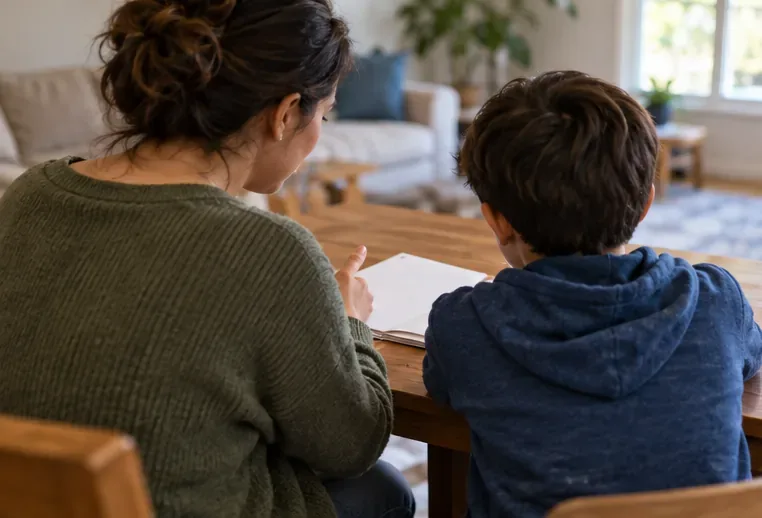
A caregiver listens beside a child at home; the child’s own account can explain which parts of a school task feel easy or difficult.
At a calm time, ask a few open questions: “Which part of the school day felt good?” “What made starting the writing task hard?” “What helped you get going?” Write down the child’s words as accurately as possible, with permission appropriate to their age, rather than fitting them into an adult’s preferred explanation. A child may mention noisy surroundings, confusing directions, a worry about getting the answer wrong, or something unrelated to the task. Each is information to discuss, not a diagnosis.
In the fictional example, Maya might say that she knows what she wants to write but cannot decide which sentence should come first. Her caregiver could record that statement and ask the teacher whether an oral rehearsal or a simple first-step cue helps. If Maya says something different from the adults’ observations, preserve both accounts. The mismatch is a question for the team, not a reason to dismiss either person.
Make room for the child to identify what they value about school: a friendship, a subject, a project, or a way of learning. This prevents the record from becoming only a behavior report. Avoid asking the child to rate themselves all day or repeatedly explain a difficult moment; the aim is understanding, not constant monitoring. If the child expresses distress, bring it to a healthcare professional or school counselor rather than waiting to finish a tracking project.
4. Turn the notes into a short meeting summary
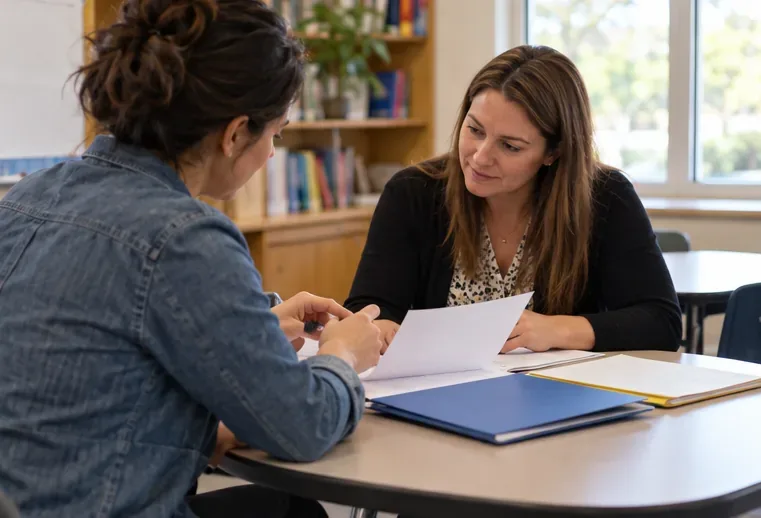
A caregiver and teacher review a short summary together, connecting observed strengths and difficulties to questions about support.
After collecting enough examples to see the issue clearly, condense them to a single page. Include the child’s strengths, two or three recurring difficulties, when they appear, what seems to help, the child’s own words, and questions for the teacher or clinician. Attach selected dated work samples if they clarify a point. State what remains unknown. For Maya, a useful question is: “Would a first-sentence prompt or a check at the start of independent writing help, and how would we know?” That is a request to discuss an approach, not a claim that it is already effective.
The CDC’s classroom guidance, dated June 2026, describes collaboration among families, teachers, and healthcare providers. It also describes organizational training, classroom behavior strategies, and possible school services or accommodations. The appropriate support depends on the child and, for formal school plans, eligibility and an individualized process. A record of school-day functioning helps frame a conversation; it does not by itself grant a particular plan.
For a healthcare visit, bring the concise summary and ask which school and home information the clinician needs. The CDC notes that there is no single ADHD test and that sleep problems, anxiety, depression, and some learning disabilities can have similar symptoms. For a school conversation, ask which observations the teacher recognizes, what support is already in place, and when the team will review whether a proposed change helped. If the child’s difficulties are affecting learning or participation, families can also ask the school how to request an evaluation; the outcome is not determined by a parent’s notebook alone.
Keep the record private and share it with people involved in the child’s care or education through an agreed channel. Revisit it after the conversation: preserve new examples of success as carefully as new concerns, note any changes in the classroom approach, and stop collecting details that no longer serve a clear question. The point of documenting a school day is to help adults understand the whole child and decide what to examine next.