Home
» 🧠 ADHD
»
ADHD Classroom Support in October: A Practical Agenda for the First School Meeting
ADHD Classroom Support in October: A Practical Agenda for the First School Meeting
An October parent-teacher meeting can become a long list of concerns with no clear next step. A better first meeting has a modest goal: describe where the child is doing well, locate one or two school-day barriers, agree on a feasible response, and decide how everyone will tell whether it helps. October is ADHD Awareness Month, but the calendar does not create a special diagnosis or a deadline for support. This agenda works whenever a family and school are ready to talk.
The guidance below is framed for a U.S. school. The CDC’s ADHD in the Classroom page, dated June 1, 2026, describes cooperation among families, educators, and healthcare providers, plus classroom strategies and possible school services. A first meeting can start that cooperation. What a particular child needs, what the school has already tried, and whether a formal plan is appropriate remain individual questions.
Before the meeting: bring a short, balanced starting point
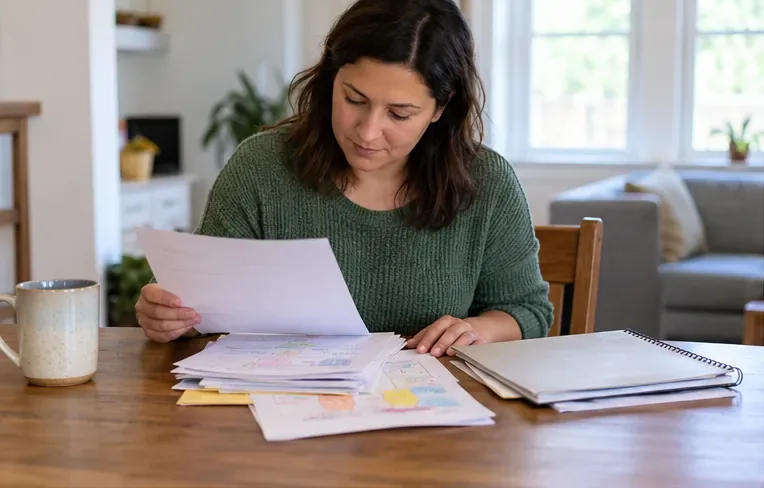
A caregiver selects a few school papers and a notebook to bring concrete strengths and concerns to the first meeting.
Send the teacher a brief purpose in advance: “I would like to understand what helps my child participate and where the school day is getting difficult.” Bring a few dated examples, such as a completed project, an unfinished assignment, or a school message. Add the child’s view in their own words if they are comfortable sharing it. A page with two strengths, two difficulties, and three questions is easier to discuss than an unsorted folder. Keep information about other students out of the packet.
A common misunderstanding is that a strong grade or a good day makes a concern irrelevant. The verified point is narrower: ADHD can affect organization, behavior, participation, and learning in different ways, and the CDC recommends looking at the individual school environment. Neither one successful assignment nor one difficult afternoon establishes what support is needed. Action: pair each concern with a specific example of success and ask what conditions differed.
Another uncertainty is the cause of a difficulty. A student who has not begun writing may be unsure of the instruction, distracted, anxious, or facing another obstacle. A family can describe what happened without assigning a diagnosis to that moment. The CDC’s diagnosis guidance, updated July 2026, says ADHD assessment involves several steps, information across settings, and consideration of other explanations. Action: write “did not begin the paragraph after the class instruction” rather than “refused to work,” then ask what the teacher observed.
At the table: hear what the child’s day looks like
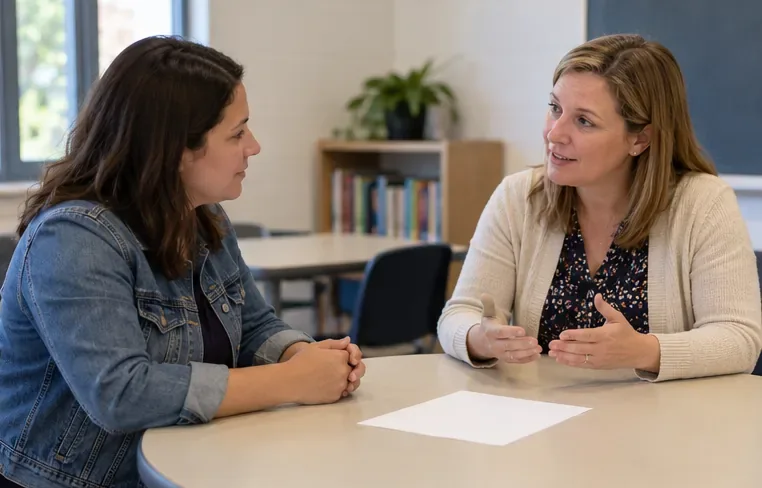
A caregiver and teacher begin by comparing what each sees and identifying the child’s successful moments at school.
Open by inviting the teacher’s account before moving to proposed solutions. Ask: “When does my child participate most easily?” “Which transition or task is hardest to start, continue, or finish?” “What happens just before the difficulty, and what happens after a prompt?” Then share what the family sees after school. A difference between home and classroom reports is information to explore, since the settings demand different skills; it is not proof that either person is mistaken.
Use the child’s experience as a third source. “What does my child say feels manageable or overwhelming?” is more useful than asking adults to speak for them entirely. If the student describes a loud transition while the teacher identifies missing materials, the group can ask whether both occur together. Avoid interpreting a single report as a settled pattern. Action: agree on one observable question, such as whether the student begins an independent task after the first direction, and on what observations would clarify it.
Agenda question
Useful answer to leave with
Where does the student thrive?
A task and setting in which a strength is visible
Where does school participation break down?
A specific routine, not a character label
What has already helped or failed?
The support tried, how consistently it was used, and the observed response
What remains unknown?
One question for observation or a professional evaluation
Choose a small classroom response and clarify the formal route
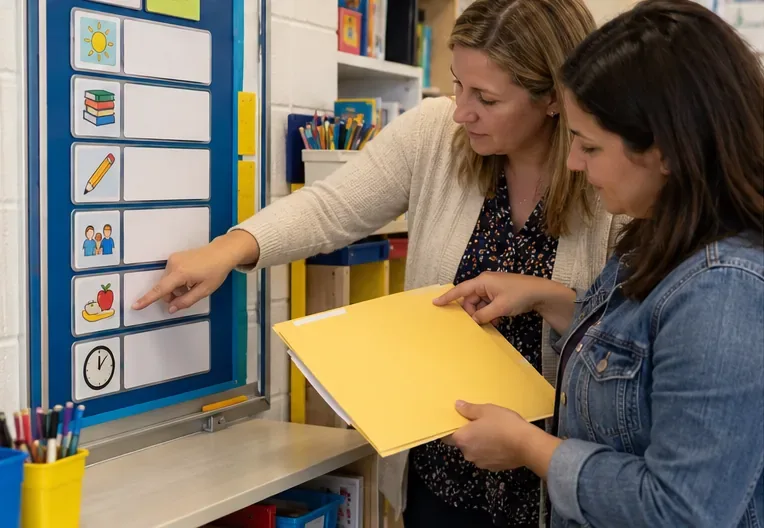
A teacher and caregiver examine a classroom schedule and folder while discussing a specific routine and possible support.
The CDC lists classroom management, organizational training, breaks, clear assignments, positive feedback, and changes that reduce distractions among possible strategies. It also notes that evidence for individual accommodations is limited. That means a list from the internet cannot tell this team which item will work for this child. If the barrier is starting independent writing, they might discuss checking that the first instruction is understood. If materials are being lost, an agreed folder routine may fit better. Action: select one manageable change tied to the observed barrier and decide what success would look like in ordinary school terms.
Do not leave “the teacher will give reminders” as the entire plan. Ask who provides the prompt, when it will happen, and how the family will learn whether the student needed less help or participated more. The child should also know what the adults agreed to in language suited to their age. A daily rating chart is one possible tool described by the CDC, not a requirement for every student. The team can choose a lighter communication method if it answers the question without making the child feel watched all day.
A different misunderstanding is that the first meeting must award a 504 Plan or an Individualized Education Program (IEP). The CDC explains that school supports may include those formal routes, depending on eligibility. An IEP under the Individuals with Disabilities Education Act (IDEA) provides individualized special education; a Section 504 plan addresses access through appropriate services and changes to the learning environment. A medical diagnosis and a school eligibility determination are related questions but are not identical. The U.S. Department of Education’s Section 504 disability-discrimination FAQ says a medical diagnosis is not a prerequisite to a public school determining disability under Section 504. Action: if the concern may require a formal evaluation, ask the school whom to contact to request one and what information the team needs; do not treat an informal classroom trial as a replacement for that request.
If the school starts an IDEA initial evaluation, the federal initial-evaluation regulation refers to a 60-day period after parental consent or a state-established timeframe, subject to specified exceptions. It is easy to mistake the first meeting date for the start of that clock. Action: ask which process is being discussed, how parental consent is handled, and which state or district timeline applies. This article cannot establish the local timeline or a child’s eligibility.
Afterward: put the agreement and review date in writing
A caregiver records the agreed classroom response and next check-in beside the meeting folder.
Before everyone leaves, restate the practical decisions: the concern to watch, the classroom response, who will do what, how a positive change will be recognized, and when the team will check in. Ask for the right contact if the teacher is not the person who handles evaluation requests. Then send a concise written recap through the school’s usual channel and invite corrections. Keep the child’s private information within the people and systems involved in their education or care.
At the follow-up, compare the same kinds of observations used at the first meeting. Did the student start more tasks, return more work, feel more comfortable, or report a new concern? Do not present a change as proof that ADHD was or was not present. If the trial is not helping, revise the approach or ask about a broader evaluation. If it helps, document the conditions so the support can be used consistently. A useful first meeting leaves a shared question and a next date, even when the team does not yet know the full answer.