Home
» 🧠 ADHD
»
Homework After the Autumn Break: A Visual Checklist for a Child With ADHD
Homework After the Autumn Break: A Visual Checklist for a Child With ADHD
After an autumn break, homework can feel harder than it did a week earlier. The school-day rhythm has paused, assignments may start arriving all at once, and a child with attention-deficit/hyperactivity disorder (ADHD) may have to rebuild routines for starting, organizing, persisting, and packing work away. A visual checklist can make those expectations more concrete. It is not a treatment for ADHD and it will not remove every homework difficulty, but it can reduce the amount a child has to hold in working memory at one time.
This article uses a clearly hypothetical example throughout. Imagine a 9-year-old child named Eli who returns to school after autumn break and comes home with a math sheet, reading log, and spelling practice. Before the break, homework usually happened with reminders from a parent. After the break, Eli wanders away from the table, cannot remember what comes first, and becomes frustrated when asked repeatedly what he still needs to do. The goal is not to make Eli finish everything perfectly. The goal is to make the sequence visible enough that he can see what to do next.
Why a visual checklist can help after a break
The U.S. Centers for Disease Control and Prevention notes that children with ADHD may benefit from predictable routines, clear and specific directions, simpler steps for complicated tasks, organized school materials, reduced distractions, and realistic goals with positive feedback. The CDC also describes organizational training and school supports as important parts of helping students with ADHD succeed. See the CDC guidance on ADHD treatment and behavior-management strategies and ADHD in the classroom.
A visual checklist turns those broad principles into a small home routine. Instead of saying, “Do your homework, read, check your folder, and pack your bag,” a parent can point to one visible sequence. For a child who loses track of multi-step instructions, this can make the task feel more finite.
Start by making the school materials visible. In the example, Eli empties the backpack and identifies what actually needs attention before beginning work.
The four-part visual checklist
For the first week back, keep the checklist short. Four stages are often easier to scan than a long list of every possible homework behavior. In Eli’s example, the family uses this sequence:
Open the backpack and find today’s work.
Choose the first task and mark it on the visual list.
Work for one manageable block, then take a planned break if needed.
Put finished work in the folder and pack the backpack.
If a child has several assignments, each stage can contain two or three small items. The visual should show only what is needed now. A crowded chart with ten boxes, extra decorations, and multiple reward systems can create another source of distraction.
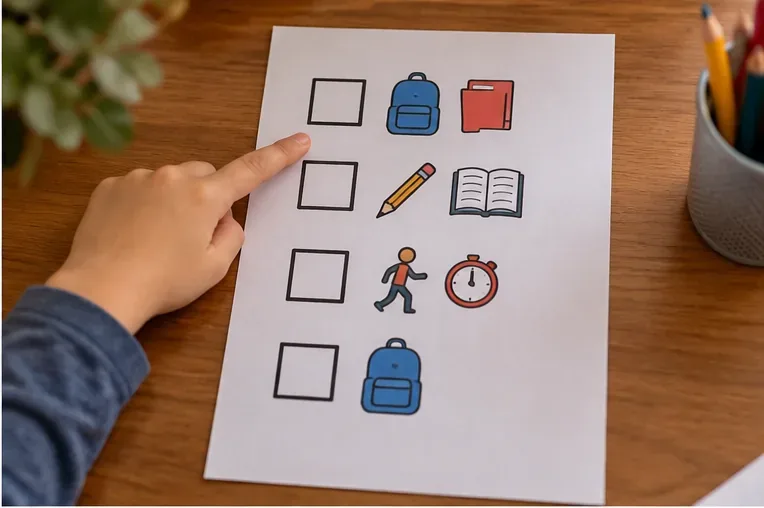
A picture-based checklist can reduce the amount of spoken information a child must remember. Simple icons and a few boxes are enough; decorative detail is optional.
How to set it up on the first day back
1. Reset the homework station before homework starts
Remove unrelated papers, toys, and screens from the immediate work area. Put the pencil, eraser, water, folder, and current assignment within reach. The CDC advises families to manage distractions and create a clean workspace, while also observing the individual child because some children work better with movement or background sound and others do not.
For Eli, that means the television stays off, the game tablet is moved to another room, and only the math sheet and pencil are placed on the table. The reading book remains nearby but out of the center of the workspace until math is finished.
2. Build the checklist with the child, not just for the child
Ask the child what usually gets forgotten. Common answers may include “I forget to bring the folder,” “I do the work but leave it on the table,” or “I don’t know which subject to start.” Turn those specific trouble spots into visible steps.
For Eli, the family chooses four icons: backpack, pencil-and-book, timer-and-walking figure, and backpack again. Under the second icon, the parent writes only the three assignments due the next day. The checklist is placed on the table where Eli can see it without turning around.
3. Decide what “done” means before starting
A vague instruction such as “finish your homework” can lead to arguments about whether the task is complete. Define completion in observable terms. For example: “Math is done when all assigned problems are attempted and the sheet is in the homework folder.” If the teacher has specific expectations, use those instead.
The American Academy of Pediatrics states that school programming and supports are part of ADHD management and emphasizes family-school partnership. Depending on the child and school, supports can include organizational help, modified assignment demands, or other accommodations when appropriate. See the AAP clinical practice guideline on ADHD. A home checklist should align with, not contradict, the child’s school plan.
4. Use one work block at a time
Do not assume every child needs the same timer length. A timer is a cue, not a test of endurance. For one child, ten focused minutes may be realistic; another may comfortably work longer. Start with a period the child can usually manage, then adjust based on the quality of work and stress level.
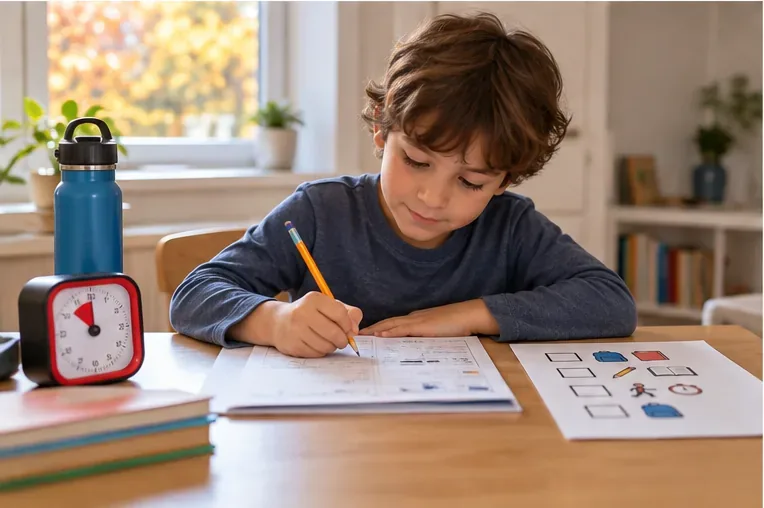
During a work block, keep the checklist visible and the workspace simple. A timer can mark the beginning and end of a manageable period without turning the session into a race.
In the hypothetical example, Eli begins with one math work block. The parent says, “Math first. The timer will tell us when to check in.” If Eli finishes before the timer, the next step begins. If he is still working when it ends, the parent checks whether he needs a short movement break, help understanding the directions, or simply a little more time.
What the parent says matters as much as the chart
A visual checklist works best when it reduces repeated verbal prompting rather than adding more. Try brief, neutral cues such as “Check the next box,” “What does the picture show?” or “Which step are you on?” This shifts some responsibility back to the visible routine.
Positive feedback should be specific. Instead of “Good job,” say, “You checked the list and put the math sheet straight into the folder.” The CDC recommends realistic goals and praise or other rewards for positive behaviors. The emphasis can stay on the process: starting, checking, returning after a break, and packing materials.
A sample after-break checklist
Stage
What the child sees
What the adult does
1. Unpack
Backpack icon and one empty checkbox
Ask the child to find the assignments; avoid listing them from memory unless help is needed.
2. Choose
Today’s two or three tasks
Help prioritize by due date, difficulty, or the child’s current energy.
3. Work and pause
Pencil plus timer/movement icon
Use one manageable work block; offer a planned movement or water break when useful.
4. Pack
Folder and backpack icon
Check that finished work is in the correct place and tomorrow’s materials are packed.
How to tell whether the checklist is actually helping
Do not judge success only by whether every assignment is finished. Over the first one to two school weeks, look for practical changes:
The child starts with fewer repeated reminders.
The child can identify the next step by looking at the checklist.
Homework materials are lost less often.
Transitions back from breaks become easier.
Arguments or frustration around “What am I supposed to do?” decrease.
The checklist itself is used rather than ignored.
If none of these improve, simplify the system. The list may be too long, the work period too demanding, the environment too distracting, or the assignment itself may be unclear. A visual system should lower the planning burden, not become another assignment.
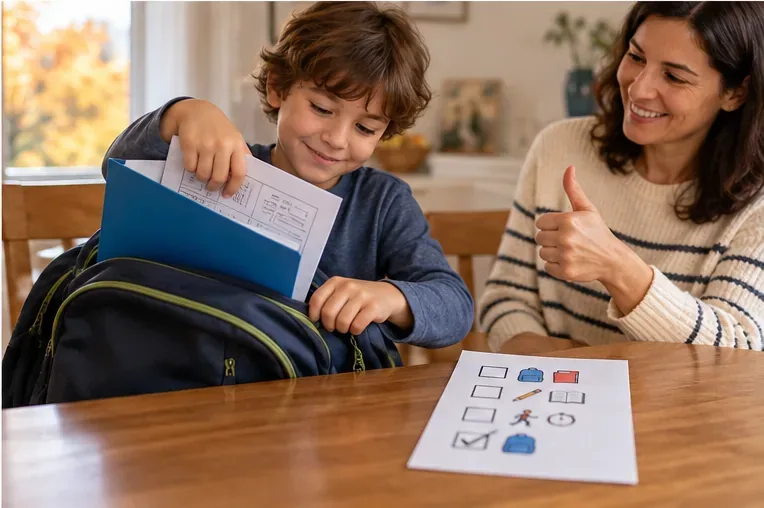
End the routine with a visible closing step: completed work goes into the correct folder and the folder goes into the backpack. Specific praise can reinforce the organization process.
Common mistakes to avoid
Making the chart too detailed. A checklist with many tiny behaviors may be harder to use than the homework itself.
Changing the routine every day. The first week back is a good time to restore a predictable sequence before experimenting with extras.
Using the checklist as punishment. It should function as an external support, not as a record of failures.
Expecting independence immediately. A parent may need to model the routine, point to the list, and gradually reduce prompts.
Ignoring school instructions. The home plan should reflect the actual assignments, teacher communication, and any IEP or Section 504 supports that apply to the child.
Assuming one sensory environment fits every child. Some children need quiet; others regulate attention better with movement or low-level sound. Observe what improves task completion without disrupting learning.
When a checklist is not enough
Homework problems can come from more than organization. A child may not understand the academic material, may have an assignment that is unusually long, may be experiencing anxiety, sleep problems, medication-related issues, learning difficulties, or other challenges. If homework regularly causes severe distress, takes far longer than teachers expect, or remains unmanageable despite reasonable supports, contact the teacher and the child’s healthcare professional rather than continually adding stricter charts.
For school-age children with ADHD, current CDC guidance notes that treatment plans may include medication, parent training in behavior management, behavioral classroom interventions, organizational-skills training, and individual school supports, depending on age and need. A visual homework checklist is best understood as one practical organizational support within that larger picture, not a substitute for professional care.
What the first week back can look like
Return to the hypothetical example. On Monday, Eli needs a parent beside him for every step. On Tuesday, he checks the first two boxes after one reminder. On Wednesday, he still resists spelling practice, so the family does not add more boxes; they ask the teacher to confirm the assignment and keep the same routine. By Friday, success is not defined as “Eli never got distracted.” Success is that he increasingly knows where to look when he forgets what comes next.
That is the useful role of a visual checklist after autumn break: it makes the sequence outside the child’s head. Keep it short, concrete, visible, and easy to revise. If it helps the child start, transition, organize materials, and finish the session with less adult prompting, it is doing its job.