October Clock Change and an Autistic Child: How to Preview a New Routine
For families who rely on a predictable morning or bedtime rhythm, the autumn clock change can feel less like “an extra hour” and more like a sudden rewrite of familiar cues. That may be especially noticeable for an autistic child who uses routine, visual information, or consistent timing to understand what happens next.
There is one important 2026 update to clarify first. As of September 2026, the European Union has not ended seasonal clock changes; the current system remains in place. EU countries return to standard time on the last Sunday in October, which in 2026 is October 25. The United Kingdom also puts clocks back on October 25, 2026. In most of the United States, however, daylight saving time ends later, on November 1, 2026. Families should therefore check the rule for the place where the child will actually be sleeping. See the European Commission’s summertime guidance, the UK government clock-change schedule, and the U.S. National Institute of Standards and Technology daylight saving time rules.
Start with the part that is actually changing
A useful first step is to separate the clock change from the rest of the child’s routine. The sequence itself can often stay the same: dinner, quiet activity, pajamas, teeth, story, bed; or wake up, bathroom, breakfast, get dressed, leave home. What changes is the clock label attached to those familiar events.
This matters because many autistic children benefit from predictability and visual support, but no single method works for every child. NICE guidance recommends meaningful visual supports and attention to individual sensory needs, while NHS services commonly use visual timetables to make routines and transitions easier to understand. That is established guidance. What varies is whether a particular child prefers photos, symbols, written words, objects, a timer, spoken reminders, or no visual system at all.
Action: write down the two or three times that are most likely to feel different after the clock change, such as wake-up time, dinner, medication time, bedtime, or the school run. Do not redesign the entire day unless you need to.
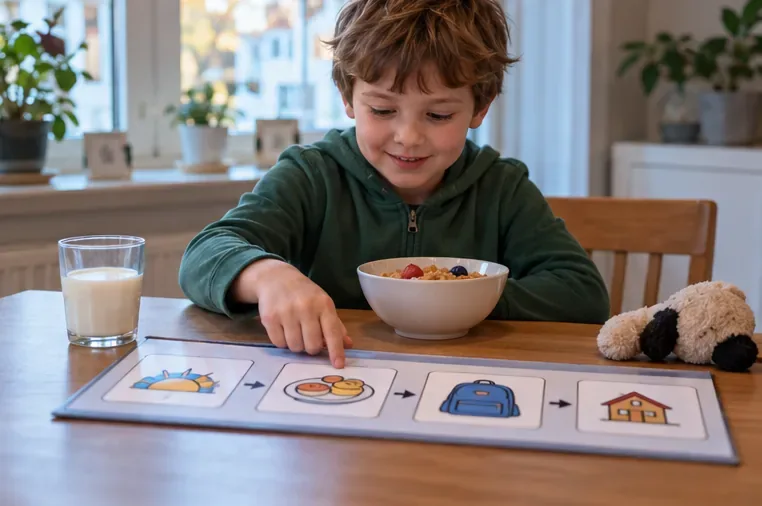
A short visual sequence can preview what stays the same even when the clock time changes.
Preview the change before it happens
A common misconception is that every autistic child needs a long countdown to a change. Some children do benefit from advance notice; others may become more anxious if a future change is discussed repeatedly for many days. The most useful amount of preview is therefore individual.
Visual timetables are well supported as a practical communication tool. Kent Community Health NHS Foundation Trust notes that they can show what activities will happen and in what order, and can reduce uncertainty around the day. The CDC also describes visual schedules and written or drawn routines as part of structured approaches that use consistency and visual learning. See the Kent NHS visual timetable guidance and the CDC overview of autism interventions and structured learning.
For the clock change, the preview can be extremely simple:
“Saturday: bedtime as usual.”
“During the night, the clocks go back one hour.”
“Sunday morning: the clock will show a different time, but breakfast still comes after getting dressed.”
“Monday: school happens as usual.”
If the child uses pictures, show the ordinary routine with one extra card for “clock changes.” If the child understands written language better, a short written explanation may be enough. If calendar dates cause confusion, use “today / tonight / tomorrow” instead of a large monthly calendar.
Action: choose one preview format the child already understands. Familiar communication is usually more useful than introducing a brand-new system just for daylight saving time.
Decide whether to shift the routine gradually
There is good general pediatric sleep guidance for making clock changes gradually. The American Academy of Pediatrics’ HealthyChildren.org advises nudging naps and bedtime in the direction of the clock change by a few minutes each day, ideally beginning about a week in advance for younger children. NHS sleep guidance likewise emphasizes consistent routines and, when needed, gradually shifting bedtime rather than making a large abrupt change. See HealthyChildren.org’s daylight saving time guidance and NHS healthy sleep routine guidance.
That does not mean every autistic child should be moved by exactly 10, 15, or 20 minutes per night. There is no universal autism-specific schedule for the October change. Some children tolerate an immediate one-hour shift with little difficulty. Others do better when meals, bedtime, wake time, and key transitions move in smaller steps.
A practical approach is to watch the child rather than chase a mathematically perfect schedule. If moving bedtime slightly later over several evenings leads to more distress, overtiredness, or prolonged settling, return to the last workable routine and adjust more slowly.
Keep the bedtime sequence familiar; only the timing may need to move gradually.
Action: if you plan a gradual shift, keep the order of bedtime activities unchanged and alter only the timing. Consistency in sequence can make the change easier to interpret.
Use the clock as one cue, not the only cue
Children do not sleep because a clock says 8:00 p.m. Sleep timing is influenced by the body’s circadian rhythm, prior wake time, activity, light exposure, naps, and individual biology. After clocks go back, a child may feel sleepy “too early” by the new clock time or wake earlier than the family expects.
HealthyChildren.org notes that natural daylight can help the body adjust after a time change, and NHS sleep guidance emphasizes regular wake times, calming evenings, and a sleep-friendly environment. For autistic children, sensory factors can be especially relevant: a room that becomes suddenly darker in late afternoon, a noisy heating system turning on for autumn, or a different feel of pajamas or bedding may matter as much as the clock.
Action: preserve the child’s usual morning light exposure, daytime activity, and calming evening cues as much as practical. If darker evenings are difficult, prepare the lighting transition deliberately rather than allowing the room to change abruptly.
Show exactly what “one hour back” means
Another misconception is that explaining “we gain an hour” is always helpful. For a child who interprets language literally, that phrase can create more questions than answers. Nobody physically receives an hour, and the child’s body may not feel different at all.
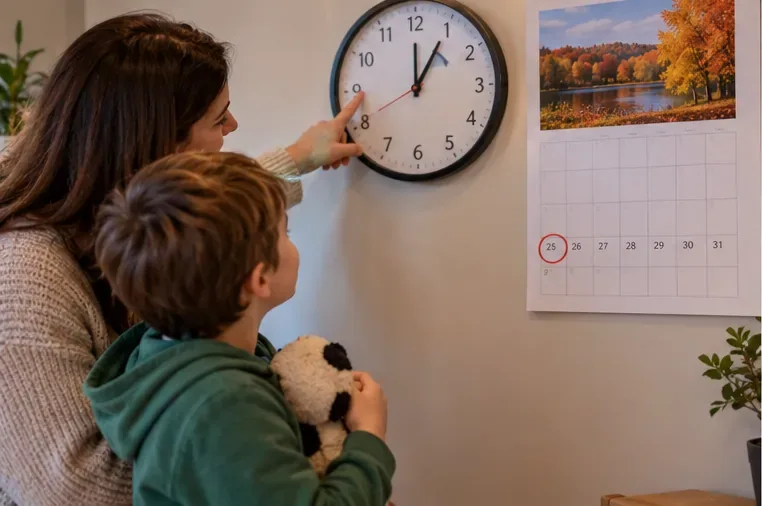
A concrete explanation is often clearer: “At night, the clock number changes. When you wake up, the clock may say 6:30 even though your body feels like it is later.” You can demonstrate by moving the hands on an analog clock or showing two screenshots or printed clock faces. Keep the explanation tied to what the child will actually experience.
Concrete cues such as a clock and marked date can make the change easier to understand for some children.
Action: rehearse the explanation once or twice, then stop unless the child asks for more information. Repetition can be reassuring for one child and stressful for another.
Preview the morning, not just bedtime
Families often focus on bedtime and forget that the first difficult moment may be the next morning. After the autumn change, a child may wake at what the clock now labels an earlier hour. Breakfast may seem delayed, a caregiver may still be asleep, and a favorite program or activity may not happen when expected.
A short morning strip can reduce ambiguity:
wake up
bathroom
breakfast
get dressed
preferred activity
leave home or begin the day
If the child wakes very early, decide in advance what happens. For example, “If it is still sleep time, you can stay in bed with books,” or “If you are awake, you can come to the quiet corner until breakfast.” The best plan depends on age, safety, communication needs, and the household.
A morning visual can answer the practical question “what happens next?” after the clock changes.
Action: make the Sunday morning plan visible before Saturday night. That is often more useful than trying to explain it when everyone is tired.
Keep sensory changes in view
The clock shift is not the only autumn change happening at the same time. Morning light, evening darkness, temperature, clothing, school schedules, and household heating may all change within a few weeks. NICE recommends considering sensory sensitivities such as lighting and noise when supporting autistic children. See the NICE autism guidance for children and young people.
If a child becomes unsettled after the time change, avoid assuming that the clock is the sole cause. Check whether the bedroom is darker or brighter, whether a radiator clicks on at night, whether heavier pajamas feel uncomfortable, or whether morning transportation is now happening in different light.
Action: change one variable at a time when possible. That makes it easier to identify what is actually helping.
What if sleep gets worse?
One or two disrupted nights around a clock change do not necessarily indicate a new sleep disorder. But persistent sleep problems deserve a broader look. NICE recommends assessing the specific sleep difficulty, day and night sleep patterns, bedtime regularity, sleep environment, physical discomfort, medication effects, daytime activity, and the impact on the family.
Seek advice from the child’s pediatrician, primary care clinician, or relevant autism/sleep service if sleep problems are persistent, severe, or affecting daytime functioning. Also seek clinical advice if there are concerns such as loud snoring or breathing pauses during sleep, significant pain or reflux, unusual nighttime events, or major changes after a medication adjustment. Do not start melatonin or other sleep medicines solely because the clocks changed without discussing it with an appropriate clinician.
Action: if problems continue, keep a brief sleep log for several days: bedtime, approximate sleep time, night waking, wake time, naps, and anything unusual. That gives a clinician more useful information than a general statement that sleep is “bad.”
A simple family checklist for the week before
Confirm the date: October 25, 2026 in the UK and EU countries that use the seasonal change; November 1, 2026 in most of the U.S.
Choose the preview: photos, symbols, words, objects, or a short spoken explanation.
Keep the sequence: preserve the usual order of bedtime and morning activities.
Decide on timing: gradual shift or one-step change, based on the child’s past response.
Prepare Sunday morning: especially if early waking is likely.
Check sensory factors: light, temperature, noise, clothing, and bedding.
Coordinate adults: use the same explanation and routine across caregivers when practical.
Review, don’t overcorrect: make small changes based on what the child actually shows you.
How to tell whether the preview worked
The goal is not a perfectly timed bedtime on the first night. A more useful measure is whether the child understands what is happening and can move through the routine with a manageable level of support.
After two or three days, ask: Is the child checking the visual plan less often? Are transitions easier than on the first morning? Is bedtime returning toward the usual pattern? Are sensory issues or early waking still causing difficulty? If the routine is settling, keep it stable. If one point remains difficult, adjust that point rather than rebuilding the whole schedule.
For an autistic child, previewing the October clock change is less about teaching timekeeping and more about preserving predictability while one familiar cue changes. A short, concrete explanation, a familiar visual system, and a calm plan for bedtime and the following morning are often enough to make the transition more understandable.