After an Autumn Outing: Four Turn-Taking Games That Make Room for Your Childs Story
An autumn outing gives a child something real to talk about: the crunchy path, the duck at the pond, or the leaf they chose to carry home. Yet “Tell me everything we did” can be a surprisingly big request. A short game with a photograph or one familiar object gives the conversation a starting point and a reason for each person to take a turn.
The goal is a shared exchange, not a polished report of the day. Listen for your child to communicate an idea, respond to what you said, or add something new. A point, gesture, spoken word, phrase, or an established communication device can all be meaningful turns. These games are ways to practice talking together; they do not diagnose or treat a speech or language difficulty.
Start with a small, observable goal
Choose one memory from the walk and one or two simple materials: large printed photos, a leaf, or a large object collected with appropriate supervision. Sit where your child can see both your face and the item. Say one thing about it, then pause long enough to give your child room to respond. If they point to a photo, answer the point: “You picked the duck. It was swimming.” That response shows that their contribution changed the conversation.
For a child ready for a longer exchange, try a comment, their response, and one follow-up: “I saw a red tree.” “A big one.” “Yes, the big red tree by the bridge.” The CDC's 3-year milestones, updated May 15, 2026, include a conversation with at least two back-and-forth exchanges. This is a population milestone, not a required score for every game or an individual assessment. The CDC also recommends speaking in slightly longer sentences than the child's and following the child's lead during outdoor play.
Four turn-taking games for the outing you just had
1. Pick the picture
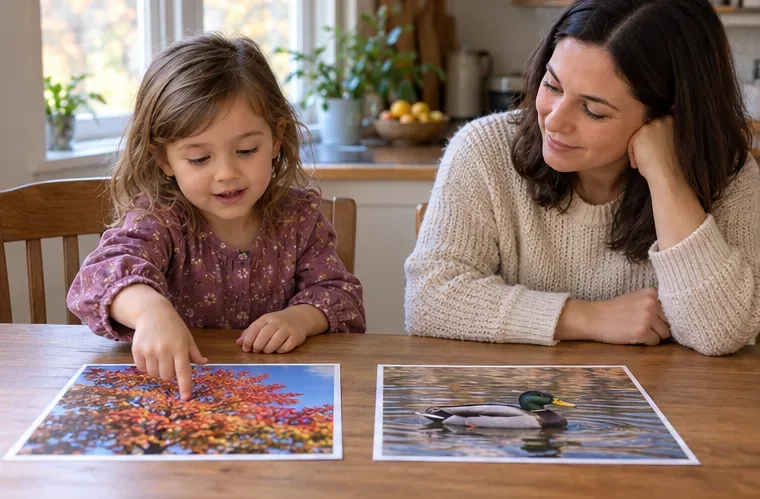
Set out two large photos from the same trip. Ask, “Which part should we talk about?” and wait. Accept a point or a spoken choice, then comment on the selected picture rather than asking several questions at once. You might say, “You chose the ducks. I remember the water was rippling.” Pause again. If your child says “duck,” add a little meaning: “The duck swam close.”
Look for: a deliberate choice and a response to your comment, even if it is a gesture. Change it when: two photos are distracting; use just one and let the child point to a detail. If the child is ready for more, invite a comparison: “Which place was quieter?”
A child chooses between two outing photos, giving the caregiver a specific memory to respond to.
2. Pass the leaf, pass the idea
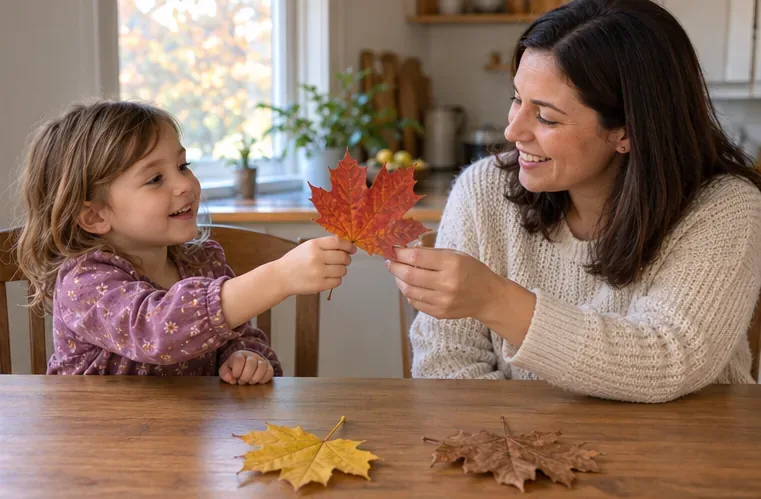
Place a large leaf between you. Hold it as you offer one observation: “This leaf has pointy edges.” Hand it over and wait. The child may say “red,” describe how it feels, or simply show you a part of it. Respond to that idea before taking another turn. The leaf makes the exchange visible, but there is no need to insist that the child speak only when holding it. If the object becomes a distraction, put it down and keep talking.
Look for: the child noticing or adding something you had not said. Change it when: passing feels like a rule test; keep the leaf in view and take turns pointing instead. Avoid brittle, sharp, or potentially irritating plants, and supervise natural materials.
Passing a large leaf creates a visual cue for sharing observations about the outing.
3. Mystery-bag memory
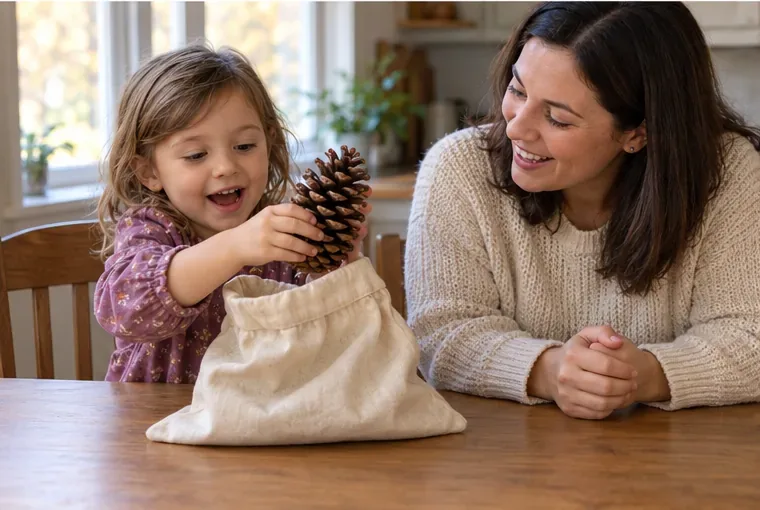
Put one large, safe item from the outing in a cloth bag, such as a pinecone. Invite the child to pull it out. Instead of asking them to name it immediately, begin with your own memory: “We found this under a tree.” Wait for their response, then follow their topic: “It feels bumpy,” or “You remember carrying it.” If they make an unexpected association, explore that association rather than steering them back to a script.
Look for: a new description, request, memory, or question. Change it when: guessing is frustrating; show the item from the start. Check objects for sharp parts and choose sizes appropriate for the child's age and needs; a small object that could be mouthed does not belong in this game.
A familiar pinecone gives the child an object to show, describe, and connect to the walk.
4. First, then, last
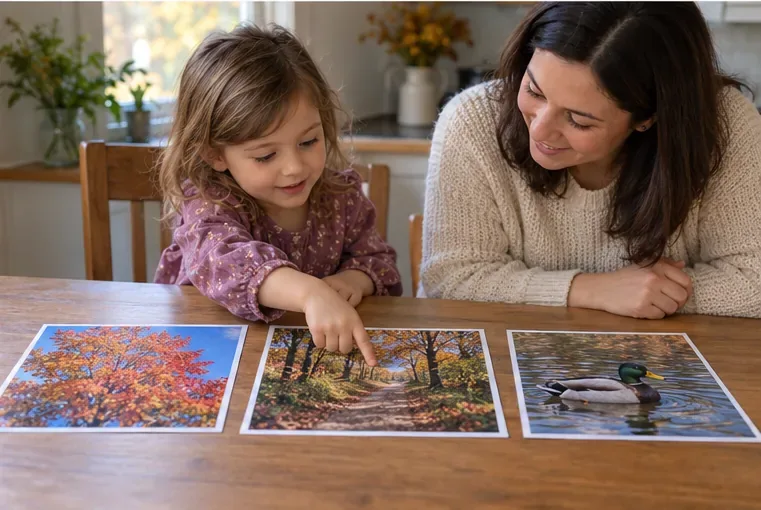
Lay out two or three photos from the trip. Tell a very short version first: “First we walked under the trees. Then we saw a duck.” Invite your child to move a photo, add a detail, or correct you. A child who says “No, duck first!” has made a useful conversational turn. For a child comfortable with this, ask what happened after the photo or how they felt at that moment.
Look for: the child contributing to the sequence or making a link between events. Change it when: ordering pictures crowds out conversation; choose one favorite photo and talk about what was happening there. The CDC's 4-year guidance, also updated May 15, 2026, suggests using words such as “first,” “second,” and “finally” when telling stories or doing chores. Children need not reproduce a perfect timeline to take part.
Three photos help the pair talk about what happened first, next, and later on the walk.
How to tell whether the practice is working
Notice participation across several relaxed attempts, rather than counting correct words in one sitting. A helpful session might contain one child-initiated point, a spoken comment about the photo, or a response that changes what you say next. Other useful signs are that your child returns to the topic, chooses a different photo to discuss, or asks you a question. A child may communicate more on a quiet afternoon than after a tiring outing.
Keep your own language manageable. One comment followed by a pause often leaves more room than a stream of “What is this?” questions. When the child speaks, repeat the idea and add a little: “Leaves fell” can become “Yes, the yellow leaves fell beside the path.” The expansion is a model, not a demand that the child repeat the sentence. If the child looks away, grows upset, or stops participating, end the game or return to ordinary play. Success includes a pleasant interaction that the child wants to revisit.
Adapt the turn to the child
For an emerging communicator, offer a clear choice and treat a point, gesture, sign, or communication-device selection as an answer. Model a word alongside it without withholding the item or requiring imitation. For a child using an augmentative and alternative communication (AAC) system, keep their familiar system available, model relevant words on it if that is part of their support plan, and allow processing time. ASHA's early-intervention AAC guidance describes AAC as a communication support that need not impede speech development.
For a child who speaks in longer sentences, ask an open but focused question, such as “What surprised you by the pond?” Then share your answer too. You can practice telling a listener who was not there what happened, using a photo as a reminder. If the family uses more than one language, speak naturally in the language you use together; the memory and exchange matter more than choosing English vocabulary for the game.
Know the limits and when to ask for help
These activities can create opportunities to communicate, but a game cannot establish why a child is hard to understand, rarely responds, or struggles to follow conversation. Progress is uneven, and the number of turns in a home game is not a clinical measure. If you are concerned about speech, language, or hearing, if your child has lost a skill, or if expected milestones are missing, discuss what you observe with a pediatrician and ask about screening or a speech-language evaluation. Do not wait for a season of practice to pass before raising a concern. The American Speech-Language-Hearing Association's early-identification guide explains signs to watch for and the roles of speech-language pathologists and audiologists.
After the next outing, choose just one photo or object, invite one exchange, and stop while the child is still engaged. The best result is a child whose idea has been heard and answered, with another chance to talk when the next memory comes up.