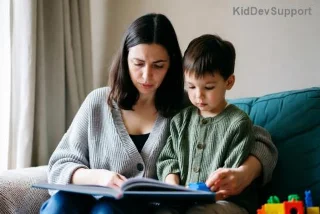
Imagine your little one excitedly repeating every phrase you say, but when you ask a simple question, they echo it right back instead of answering. Sound familiar? This could be echolalia – a common behavior where children mimic words or phrases without fully grasping their meaning. As a parent, spotting child mimicking words without meaning can spark worry, but understanding it is the first step to helping your child thrive. In this guide, we'll break down echolalia in children, its links to conditions like autism, and proven strategies to support speech growth. Stick around – you'll leave equipped to take action. ⚕️
What Exactly Is Echolalia? A Clear Definition
Echolalia is the automatic repetition of words, phrases, or sounds spoken by others. It's not random babble; it's a child's brain processing language in a unique way. While all toddlers mimic to learn speech, echolalia in children persists beyond typical development, often without communicative intent.
Recent studies from leading speech experts highlight that up to 75% of children with autism spectrum disorder (ASD) exhibit echolalia, but it also appears in other conditions like developmental delays or even typical kids under stress. The key? It bridges the gap between hearing and meaningful expression, acting as a "language scaffold."
Types of Echolalia: Immediate vs. Delayed
Not all echolalia is the same. Here's a quick breakdown:
| Type |
Description |
Example |
Common in |
| Immediate Echolalia |
Repeats words right after hearing them |
Parent: "Want juice?" Child: "Want juice?" |
Younger kids, early autism |
| Delayed Echolalia |
Repeats phrases from past (TV, songs) |
Child says "To infinity and beyond!" randomly |
Autism, scripting for comfort |
Curious how this plays out daily? Keep reading for red flags that signal it's time for professional input.
Signs Your Child Has Echolalia: Spotting Child Mimicking Words Without Meaning
Every child develops uniquely, but persistent echolalia stands out. Watch for:
- Repeating questions instead of answering (e.g., "Are you hungry?" echoed back).
- Using scripted phrases from media out of context.
- Limited original speech; heavy reliance on echoes.
- Paired with social challenges, like avoiding eye contact – a hallmark of autism echolalia.
According to the latest guidelines from the American Speech-Language-Hearing Association (ASHA), if echolalia dominates after age 3, evaluation is crucial. But don't panic – many outgrow it with support.
![Signs of echolalia in children with speech therapy]()
Causes of Echolalia in Children: Beyond Just Mimicry
Why does child mimicking words without meaning happen? It's often a symptom, not the root. Primary links include:
Autism Echolalia: The Strongest Connection
In ASD, echolalia helps process overwhelming input. New research shows it as an early communication tool, evolving into functional speech with therapy.
Other Triggers
- Speech delays: Processing lags lead to echoing as a default.
- Intellectual disabilities or hearing issues.
- Even anxiety or excitement in neurotypical kids.
Pro tip: Track patterns in a journal – timing, triggers – to share with specialists. Wondering about diagnosis? Next up...
How Is Echolalia Diagnosed? Steps for Parents
Diagnosis starts with your pediatrician, who may refer to a speech-language pathologist (SLP) or developmental specialist. Tools include:
- Observation via play-based assessments.
- Standardized tests like the ADOS for autism ties.
- Hearing and cognitive screenings to rule out other causes.
The CDC emphasizes early screening – by age 2 for high-risk kids. Early catch means faster progress! 🌟
Treatment for Echolalia: Effective Therapies That Work
Great news: Echolalia is highly treatable. Focus on functional communication:
Speech Therapy: The Gold Standard
SLPs use techniques like:
- Prompting original responses.
- Visual aids (PECS) to reduce reliance on echoes.
ABA and Other Interventions
Applied Behavior Analysis (ABA) rewards novel speech. For autism echolalia, social stories curb scripting.
Home Strategies for Parents
| Strategy |
How to Implement |
Expected Benefit |
| Pause After Speaking |
Wait 5-10 seconds for response |
Encourages thinking over echoing |
| Model Simple Choices |
"Apple or banana?" |
Builds functional language |
| Expand Echoes |
Child echoes "ball"; say "Yes, big red ball!" |
Turns mimicry into learning |
Consistency is key – combine home efforts with pro therapy for breakthroughs. 💪
When to Seek Help: Red Flags for Speech Delay Echolalia
Act now if:
- No words by 18 months or phrases by 24.
- Echolalia increases with age.
- Accompanied by regression or behaviors like hand-flapping.
Early intervention programs offer free services – contact your local early childhood services today.
Success Stories: Kids Overcoming Echolalia
Meet Alex, who at 3 echoed TV lines constantly. With SLP sessions and parental modeling, by 5 he chatted fluidly. Stories like his prove progress is possible. 😊
Final Thoughts: Empower Your Child's Voice Today
Echolalia isn't a dead end – it's a signpost to better communication. By recognizing child mimicking words without meaning, seeking expert help, and applying daily tips, you're setting your child up for success. Consult your doctor, start therapy, and celebrate small wins. Your child's meaningful words are closer than you think!
Ready for more? Share your story in comments or explore our speech delay resources.