Halloween Picture Cards: Helping a Child Request and Choose
Halloween picture cards can give a child another way to say what they want, reject an option, or choose between activities. A small set might show a pumpkin craft, a favorite book, a costume hat, or “all done.” These cards can be homemade and simple. The useful question is whether the child understands and can access them—not whether they look polished.
Picture cards are one low-tech form of augmentative and alternative communication (AAC), a broad term for tools and strategies that supplement or support communication. A card can sit alongside speech, signs, gestures, eye gaze, or a child’s existing communication system. ASHA’s guidance emphasizes matching AAC to the individual and communication partners; it does not require a child to stop speaking or use only pictures. If the child already has an AAC system, keep it available and follow the family’s speech-language pathologist’s guidance rather than replacing it with a seasonal board.
What should Halloween picture cards help the child communicate?
Start with real things the child may want to communicate during a Halloween routine. Think beyond naming decorations or choosing a treat. Useful messages might include “pumpkin,” “read,” “costume,” “music,” “help,” “more,” “stop,” “break,” “no,” and “all done.” A child who can say a word may still benefit from a picture when excited, tired, or choosing among several activities.
Make sure the child can reject or change a choice. If the board only offers adult-approved activities, it may not provide meaningful communication. Add a clear way to say “no,” “something else,” or “finished,” using the child’s familiar words, signs, gestures, or symbols. Do not make access to a needed item, comfort, or communication depend on producing a perfect card exchange or spoken word.
Which card style is a better fit: photos or symbols?
There is no single best image style for every child. A photograph of the child’s own pumpkin bucket may be immediately recognizable. A simple drawing or symbol can be easier to reuse across different objects and settings. Try the option the child notices and understands most readily, and check it during an actual routine. If the child does not recognize a picture, change it instead of repeating the same prompt louder or more often.
Choice
Possible advantage
Tradeoff to consider
Photos of familiar items
They can closely match the child’s own costume, book, or craft materials.
A photo may represent only that particular item; it may not be obvious that it means a broader category.
Simple symbols or drawings
They can be reused across people and settings and may fit an existing AAC vocabulary.
The child may need opportunities to learn what the symbol means; avoid switching symbol styles without a reason.
Two cards at a time
A small array can make it easier to scan and compare options, especially at first.
It limits the choices available. Keep a way to request another option or reject both.
A larger choice board
It can include more activities and useful messages such as “help” or “stop.”
More symbols can be harder to scan or reach. Start at a size the child can manage and add options gradually.
ASHA’s National Joint Committee notes that aided communication may include objects, pictures, photographs, line drawings, and printed words, and that AAC choices should reflect a person’s needs and communication partners. See its overview of AAC options and decision-making.
How can you make and use a small card set?
1. Choose a few real messages and matching activities
Pick two or three Halloween activities the child genuinely likes, plus a message for “no,” “stop,” or “all done.” Use cards for things that are available. If the pumpkin craft is not an option today, do not leave its card where the child will reasonably expect to choose it. You can use a phone photo, a printed picture, or a simple drawing; label the card with a word if that helps the adults keep the vocabulary consistent. A label should not be a reading test for the child.
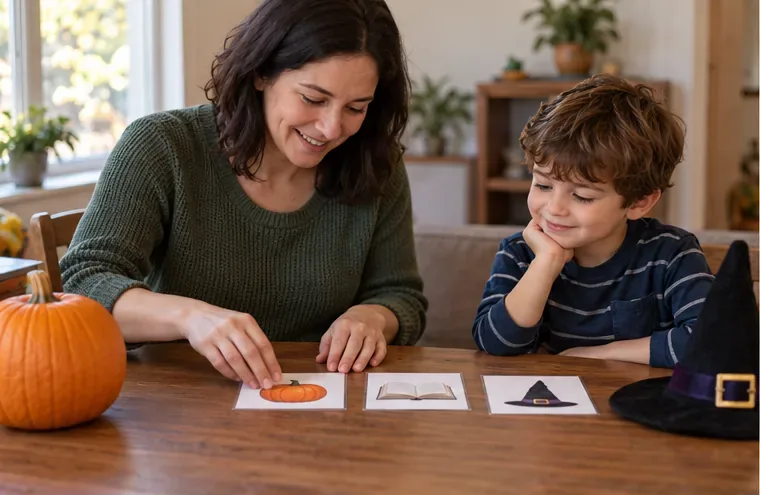
A caregiver lays out three picture cards—pumpkin, book, and costume hat—beside matching objects before offering choices.
2. Put out a real choice, then pause
Place two cards where the child can see and reach them, with the matching items or activities available. Say a short phrase such as “Pumpkin craft or book?” You can point to each card while naming it. Give the child time to look, point, reach, vocalize, sign, speak, or use their usual AAC. Do not repeatedly ask “What do you want?” while moving the cards or steering the child’s hand. If the child cannot access the cards easily, adjust their position or ask the child’s SLP about access options.
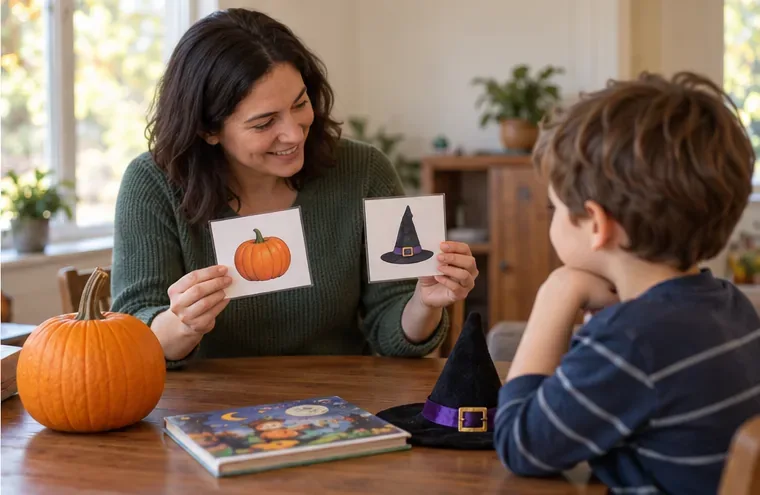
Two picture cards are presented with matching Halloween objects nearby, giving the child a clear choice.
3. Model the card without turning it into a quiz
Show how the cards work by pointing to one while saying the word naturally: “Pumpkin,” or “Let’s read.” The child can watch without copying. ASHA describes this kind of spoken language paired with AAC symbols as augmented input, and recommends modeling symbols during everyday communication. A seasonal activity is practice in a natural routine; it does not need to become a drill.
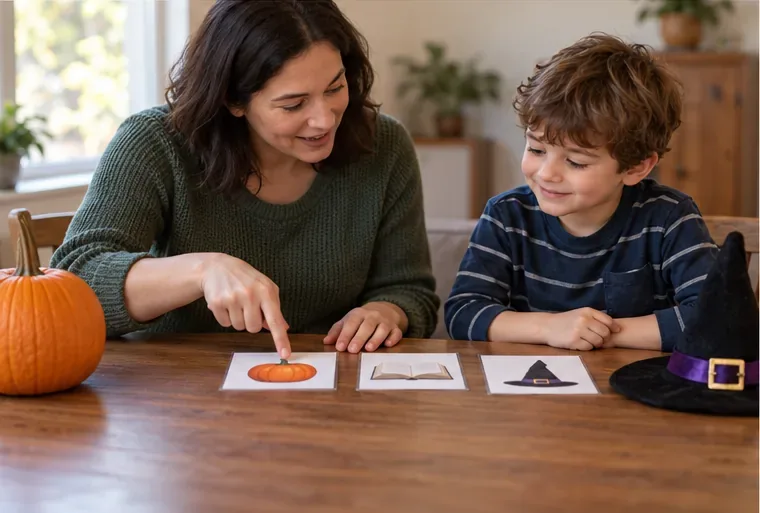
The adult models a picture and its spoken word without requiring the child to copy.
4. Respond to the child’s message
If the child points to the pumpkin card, treat that as a meaningful choice and offer the pumpkin activity. If the signal is unclear, briefly confirm—“Pumpkin?”—and watch the child’s response. If they turn away, say “No pumpkin” and offer the other choice or a way to request something else. If they reach for the book instead of selecting a card, honor that communication too. The goal is a successful exchange, not perfect use of one format.
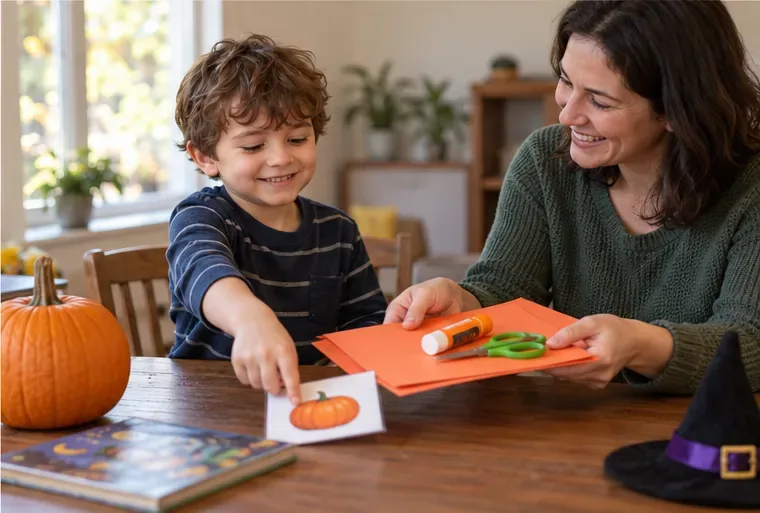
The child selects the pumpkin card, and the caregiver responds with the matching craft materials.
Should you make a quick DIY board or use an established AAC system?
A homemade card set is quick, inexpensive, and useful for a narrow Halloween choice. Its limitation is that it may not cover everyday communication, work at school, or match how the child already communicates. A dedicated AAC system may offer a broader, consistent vocabulary, but selecting and learning a system can take input from the child, family, and professionals. ASHA’s Practice Portal explains that specific programs such as the Picture Exchange Communication System (PECS) have defined procedures; a parent-made choice board is not automatically PECS. If you want to use a structured program, ask a speech-language pathologist about it rather than relying on a few online cards.
For a child with a communication delay or disability, a speech-language pathologist can help assess symbol type, layout, vocabulary, vision, movement, and partner support. That does not mean a family has to wait before offering a child a simple choice or responding to gestures. ASHA notes that picture-based supports can be one part of a broader AAC approach and encourages individualized decision-making. Read the ASHA Practice Portal on AAC and its guidance on modeling AAC in everyday routines.
How will you know the cards are helping?
Look for practical signs: the child can find a wanted card, gets an adult’s attention, makes a choice or rejects one, and sees their message respected. Notice whether the same cards work with another caregiver or during a different Halloween activity. If the child pushes the board away, repeatedly guesses, or seems frustrated, reduce the number of options, change the images, make the cards easier to reach, or return to a communication method that works better. Do not judge success by whether the child speaks more or uses cards every time. Communication can vary by person, moment, and setting.
Keep the cards available but optional. A calm, responsive adult and an accessible way to say “yes,” “no,” “help,” or “stop” matter more than a themed set of perfect cards. For a child who already uses AAC, coordinate with their communication team so Halloween vocabulary adds to—not disrupts—the system they rely on every day.