Speech Delay and Preschool Return: What to Note Before a Clinician Visit
A recent reference can make a preschool conversation more concrete: the CDC’s four-year milestone page, dated May 15, 2026, lists examples such as using sentences of four or more words, talking about something that happened during the day, and answering simple questions. The CDC also says its milestone materials are not a substitute for a validated developmental screening. Use the list to organize questions—not to diagnose your child or decide to wait.
When a child returns to preschool after a break, teachers may notice communication in group play, transitions, and noisy rooms that a family does not see at home. A short adjustment period can affect how much a child talks, but a concern that was present before the break or appears across settings deserves attention. Specific observations help a pediatrician or speech-language pathologist understand what is difficult, when it happens, and what supports help.
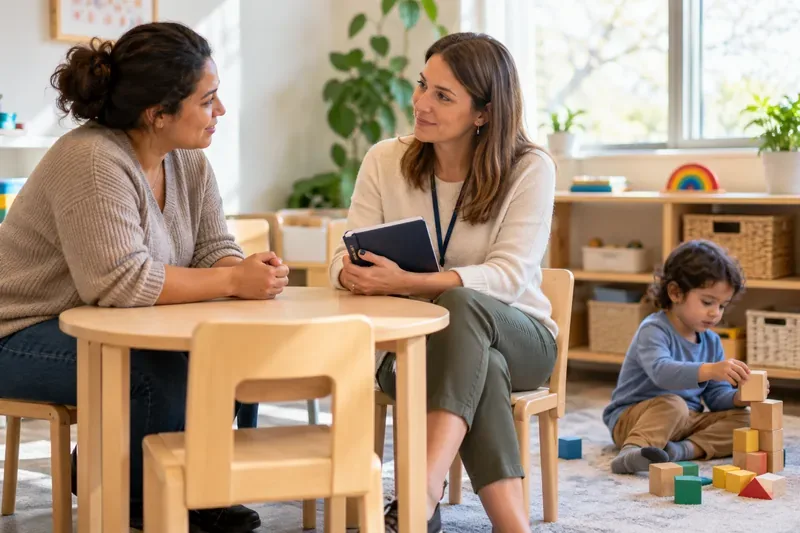
A caregiver and clinician discuss communication while a preschooler plays; examples from everyday routines can help make the conversation specific.
First, separate speech from language
People often use “speech delay” as a broad term, but speech and language describe different skills. Speech involves how a child produces sounds and words, including clarity and fluency. Language includes understanding what others say and expressing ideas with words, signs, gestures, or other communication. A child may have difficulty in one area, both, or neither; an observation is not a diagnosis.
The National Institute on Deafness and Other Communication Disorders (NIDCD) notes that difficulty understanding others or sharing thoughts can relate to language, while trouble producing sounds or fluency can relate to speech. Hearing differences can also affect speech and language development. Bring observations from daily life rather than trying to name a condition. See NIDCD’s overview of speech and language development.
What to observe after preschool resumes
Try a brief note on a few different days, including a home routine and a preschool activity. Record what happened in plain language. “Couldn’t communicate” is hard to interpret; “pointed to the cup, then said ‘water’ after I asked what he wanted” gives a clinician something concrete to follow up on.
Area
Useful observations
Example to write down
Understanding
How the child responds to familiar words, questions, and directions; whether gestures or repetition help
“Followed ‘get your coat’ after I pointed to it; needed the direction repeated in the classroom.”
Expressing needs and ideas
Words, signs, gestures, picture supports, or other ways the child asks, comments, answers, or tells a short event
“Asked for help by handing me the closed container and saying ‘open.’”
Speech clarity and fluency
Which words are hard for familiar and unfamiliar listeners to understand; repeated sounds, long pauses, or frustration
“Family understood the story; a new teacher asked for several words to be repeated.”
Back-and-forth communication
Whether the child takes turns, responds to another person, initiates play, or communicates mostly in certain routines
“Answered one question about blocks, then returned to solo play.”
Context and support
Noise, group size, fatigue, transitions, visual cues, extra wait time, familiar adults, and what improves communication
“Talked more one-to-one during snack than during circle time.”
Hearing and response to sound
Whether the child notices a name, quiet speech, or sounds from different directions; any hearing concerns or ear history
“Often missed instructions when the room was busy; responded when the adult moved closer.”
These notes are examples, not a scoring system. Children communicate differently across people and settings, and an unfamiliar or noisy classroom can make speech harder to understand. Ask the teacher for one or two specific examples, what was happening at the time, and whether a visual cue, gesture, shorter direction, or extra response time helped. A simple dated note is usually more useful than a long description written from memory.
Bring a small, balanced summary
At the appointment, it can help to bring:
Your child’s age, languages used, and a short description of who speaks each language and in which settings.
Two or three examples of communication that concerns you, plus examples of what your child does well or enjoys.
Notes from both home and preschool, including whether the pattern changed after returning from break or was present earlier.
Relevant developmental and medical history, such as prior hearing checks, ear concerns, major changes, or any loss of a communication skill.
A list of questions: “Could hearing be part of this?” “Should we request a speech-language evaluation?” and “What support is available through preschool or our school district?”
You do not need a perfect log or a recording. If a clinician asks for a short audio or video sample, ask what would be useful and follow the preschool’s privacy rules; do not record other children. Describe the child’s strongest communication as well as the moments that are difficult. That gives the clinician a fuller picture of participation, not just a list of problems.
If your family uses more than one language
Write down every language your child hears or uses, approximate contexts, and the people they communicate with. Include examples in each language, even if you can only describe them or provide a translation. Mixing words from different languages can be part of multilingual development; ASHA says using more than one language does not cause speech or language delays. If you are concerned, ask how the evaluation will consider all the child’s languages and whether an interpreter or multilingual clinician is available. ASHA’s family guidance on learning more than one language explains why families can continue using the languages they know best.
For children evaluated under the Individuals with Disabilities Education Act (IDEA), federal rules say assessment materials and procedures should be provided in the child’s native language or other mode of communication when feasible and in a form most likely to give accurate information. State and local procedures still matter; ask the school team how it will assess communication in your child’s language profile. See the U.S. Department of Education’s IDEA evaluation procedures.
What evaluation can clarify
A developmental screening is a brief, structured check of whether a child may need a closer look. A comprehensive speech-language evaluation is more detailed and may look at understanding, expression, speech sounds, communication during play, and how the child uses communication in daily routines. A clinician may also recommend a hearing evaluation because hearing can affect communication. NIDCD describes how a speech-language pathologist (SLP) gathers developmental information and uses assessment tasks; the right evaluation depends on the child’s age and concerns.
Start by telling your child’s pediatrician what you have observed and ask about developmental screening, an SLP referral, and hearing assessment. You can also ask about local service routes. In the United States, children younger than 3 may be referred to their state or territory’s early intervention program. For children age 3 and older, contact the local public school district and ask for its preschool evaluation or “Child Find” process; IDEA requires public agencies to identify and evaluate children who may have disabilities, but eligibility and services are determined individually. The CDC’s early intervention information and the Department of Education’s IDEA Child Find regulation explain these routes. State timelines and local contacts vary, so ask the relevant program directly.
When not to wait for more preschool observations
It is reasonable to note whether a child speaks more after settling back into a familiar routine, but do not use the transition as a reason to postpone asking for help when concerns are already clear. The CDC advises families to act when a child is not meeting one or more age-related milestones, has lost a skill they once had, or a caregiver has another concern. If your child has lost words or other communication abilities, contact the pediatrician promptly and describe what changed and when. A milestone list cannot tell you why a skill is difficult, and a clinician can help determine what assessment is appropriate.
One-page checklist to take along
What does my child understand in familiar and new situations?
How does my child ask, answer, comment, and share an idea?
How understandable is my child to family, teachers, and unfamiliar people?
What happens during play, group time, transitions, and quiet one-to-one routines?
Which languages, gestures, or visual supports does my child use?
What helps—and what makes communication harder?
Have I noticed a change or loss of a skill?
Bring a few specific examples rather than trying to reach a conclusion before the visit. The purpose of the conversation is to help the clinician decide whether screening, hearing assessment, speech-language evaluation, school support, or another next step fits your child.